Traditional SEO techniques remain important.
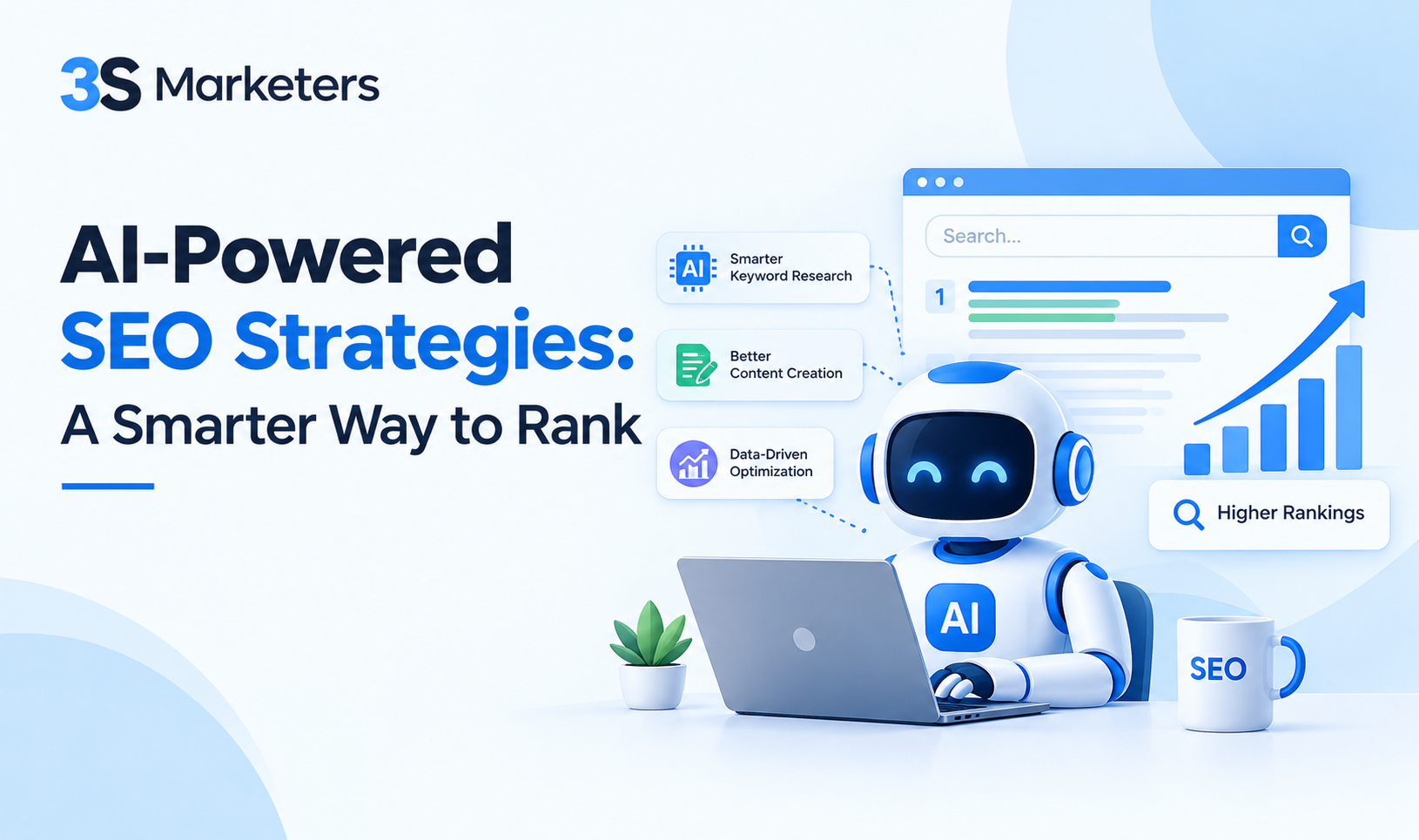
Artificial intelligence in SEO is changing how businesses research keywords, create content, analyze competitors, and improve website performance.
As search engines become better at understanding user intent, businesses need data-driven approaches like Artificial intelligence in SEO to remain competitive.
This is where Artificial intelligence in SEO can make a difference. Additionally, by combining advanced analytics with human expertise, businesses can identify opportunities, streamline repetitive tasks, and address audience needs.
Artificial intelligence in SEO can assist, but it is not a replacement for strategic thinking. The real advantage comes from using AI to support informed decisions rather than relying on automation alone.
At 3S Marketers, we believe effective SEO combines technology, experience, and a clear understanding of business goals. In this guide, we explore practical ways to use AI in SEO and turn insights into measurable improvements.
What Are AI-Powered SEO Strategies?
AI-powered SEO strategies use machine learning, natural language processing, and data analysis.
Additionally, these technologies help marketers understand search behavior, identify content gaps, analyze website performance, and prioritize optimization opportunities.
For example, AI can analyze thousands of search queries to identify related topics and common user questions.
Additionally, it can help marketers discover why competing pages attract organic traffic.
It also shows which content improvements may benefit their websites.
Unlike traditional workflows that often depend on manual research, AI-assisted SEO can process large amounts of information quickly. Nevertheless, marketers must validate the findings and ensure their recommendations align with search intent and business objectives.
7 AI-Powered SEO Strategies to Improve Rankings
1. Use AI for Smarter Keyword Research
Keyword research is the foundation of a successful SEO campaign, using Artificial intelligence in SEO. Instead of targeting individual keywords without considering their context, marketers should identify topic clusters, search intent, and related queries.
AI tools can help organize keywords into informational, commercial, navigational, and transactional categories. This makes it easier to create relevant landing pages and blog content for different stages of the customer journey.
Actionable tips:
- Identify primary keywords and relevant long-tail variations.
- Group related queries into topic clusters.
- Analyze search intent before assigning keywords to pages.
- Prioritize keywords based on relevance, competition, and business value.
- Validate search volume and ranking difficulty using reliable SEO data.
For instance, a business targeting “AI tools for digital marketing” could create supporting content around AI content optimization, marketing automation, and predictive analytics.
2. Create Helpful Content With AI Assistance
AI can accelerate content research, generate outlines, identify missing subtopics, and suggest improvements to readability. However, publishing unedited AI-generated articles can result in repetitive or generic content that fails to provide meaningful value.
A better approach is to use AI as a research and editing assistant while keeping human expertise at the center of content creation.
Start by analyzing the questions your audience asks, reviewing competing pages, and identifying information gaps. Use AI to organize these insights into a structured outline. Then add expert opinions, original examples, practical recommendations, and relevant business experience.
Actionable tips:
- Create detailed content briefs before writing.
- Address the search intent behind each target keyword.
- Add original insights and examples that competing pages may lack.
- Verify statistics, claims, and external references.
- Review every article for accuracy, clarity, and usefulness.
The objective is not to publish more content simply because AI makes production faster. It is to publish content that genuinely helps readers solve problems.
3. Optimize Existing Content With AI
Updating existing pages can be an effective way to improve organic search performance. AI-assisted analysis can help identify outdated information, missing subtopics, unclear headings, and opportunities to improve internal linking.
Begin by reviewing Google Search Console data to identify pages receiving impressions but generating relatively few clicks. Examine pages ranking near the top of search results but not yet achieving their traffic potential.
AI can help compare these pages against relevant search queries and suggest improvements. However, avoid changing content simply to include more keywords. Every edit should improve relevance, clarity, or usefulness.
Actionable tips:
- Refresh outdated examples and information.
- Improve title tags and meta descriptions where appropriate.
- Add relevant internal links to related resources.
- Expand sections that do not fully answer user questions.
- Track clicks, impressions, rankings, and conversions after updates.
Measure the results over time rather than assuming every content change will immediately improve rankings.
4. Use AI for Technical SEO Audits
Technical SEO ensures search engines can discover, crawl, render, and index important pages on your website. AI can help interpret large audit reports, group recurring issues, and prioritize fixes.
For example, AI-assisted analysis can organize findings related to broken links, duplicate title tags, redirect chains, missing metadata, and inconsistent internal linking. Some specialized tools can also help developers investigate log files or analyze structured data errors.
Still, AI-generated recommendations should be checked against actual website behavior. A suggested fix may not be appropriate for every website configuration.
Actionable tips:
- Run regular crawls using established SEO auditing tools.
- Review indexing and crawling issues in Google Search Console.
- Check canonical tags, XML sitemaps, and robots directives.
- Validate structured data using appropriate testing tools.
- Prioritize issues according to their impact on important pages.
AI can help organize technical findings, but implementation and validation remain essential.
5. Strengthen Competitor and Content Gap Analysis
Understanding competitors helps you discover opportunities that may otherwise go unnoticed. AI can assist with comparing keyword coverage, identifying recurring topics, and organizing competitor content into useful categories.
Start by selecting competitors that target similar customers and search intent. Compare their top-performing pages, keyword themes, content formats, and supporting resources.
Next, identify topics where your website lacks comprehensive coverage or offers less useful information. Use these findings to create a prioritized content plan.
Actionable tips:
- Compare keyword rankings and relevant landing pages.
- Identify questions competitors answer that your website misses.
- Review their internal linking and content structure.
- Look for underserved topics that match your expertise.
- Develop more useful resources instead of copying competitor content.
The goal is to differentiate your website through better information, stronger expertise, and a more satisfying user experience.
6. Prepare Content for AI Search Experiences
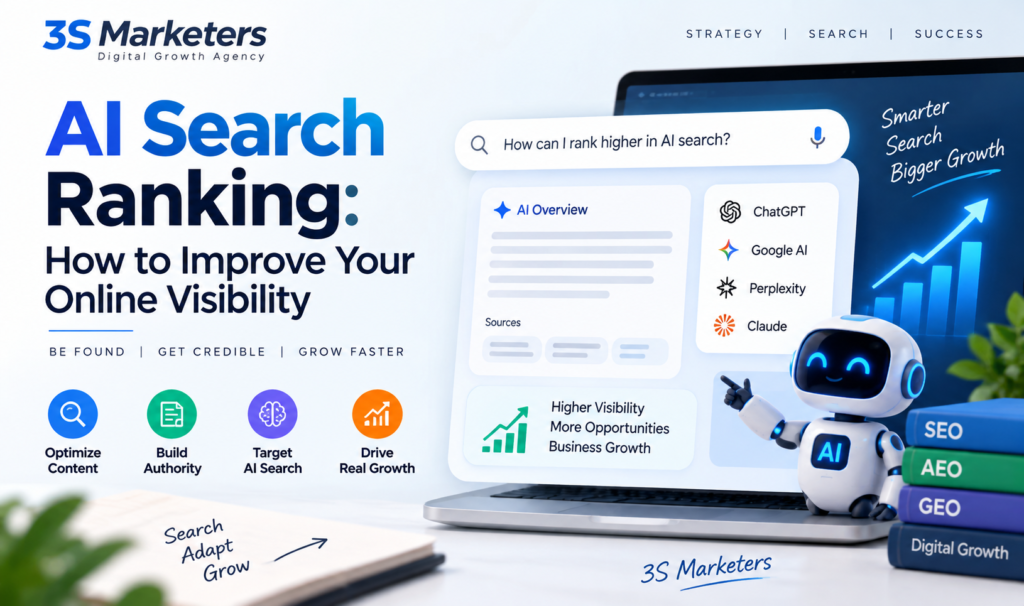
Search is expanding beyond traditional blue links. AI-powered search experiences can summarize information, combine sources, and provide conversational answers. Businesses therefore need content that is clear, accurate, well-organized, and easy to understand.
AI search engine optimization involves improving the discoverability and usefulness of website information across evolving search experiences. Although no single tactic guarantees inclusion in AI-generated answers, strong fundamentals remain valuable.
Organize content around specific questions, provide direct answers, use descriptive headings, and support claims with trustworthy evidence. Make your business expertise clear and maintain accurate information across your website and other relevant online profiles.
Actionable tips:
- Answer important customer questions directly.
- Use descriptive H2 and H3 headings.
- Include original research, expert commentary, and practical examples.
- Maintain consistent business information.
- Monitor organic traffic, referral sources, branded searches, and available AI visibility data.
Do not rely on keyword repetition or artificial mentions to influence AI systems. Focus on making your information genuinely useful and verifiable.
7. Measure SEO Performance With AI-Assisted Analytics
SEO success involves more than improving keyword positions. Businesses need to understand whether organic search attracts relevant visitors and contributes to leads, sales, or other meaningful outcomes.
AI-assisted analytics can help identify traffic patterns, detect unusual performance changes, and summarize data across multiple reporting periods. However, automated explanations should be treated as hypotheses until verified.
Combine Google Analytics, Google Search Console, rank-tracking platforms, and conversion data to develop a complete performance picture.
Actionable tips:
- Track organic clicks, impressions, and click-through rates.
- Monitor rankings for commercially relevant keywords.
- Measure leads, purchases, and conversion rates.
- Compare performance across pages, topics, and devices.
- Investigate significant changes before attributing them to a specific SEO activity.
Use these insights to refine your strategy and allocate resources to the opportunities most likely to support business growth.
Best Practices for Artificial Intelligence in SEO
The effective use of artificial intelligence in SEO requires a balance between automation and human judgment. AI can process data quickly, but it may misunderstand context, produce inaccurate information, or recommend changes that do not suit your audience.
Follow these principles to get better results:
- Maintain human oversight: Have experienced professionals review content and strategic recommendations.
- Prioritize accuracy: Verify factual claims and use reliable sources.
- Protect data: Avoid entering confidential customer or business information into tools without appropriate safeguards.
- Focus on users: Create content that answers real questions rather than content designed solely to manipulate rankings.
- Test before scaling: Evaluate results through controlled changes and performance tracking.
AI should strengthen your SEO workflow, not replace the expertise needed to make sound decisions.
Conclusion
AI is transforming SEO by making research, content analysis, technical auditing, and performance monitoring more efficient. When used strategically, AI-powered SEO strategies can help businesses uncover opportunities, improve existing content, and make better-informed marketing decisions.
However, lasting results still depend on search intent, technical quality, original expertise, and a positive user experience. AI-generated recommendations alone cannot guarantee higher rankings or consistent organic growth.
At 3S Marketers, the focus should be on combining intelligent automation with practical SEO expertise to build sustainable search visibility. By choosing the right tools, validating insights, and continuously measuring performance, businesses can adapt to changing search experiences while keeping their customers at the center of every decision.
AI-Powered SEO Strategies FAQs
How does AI improve search engine optimization?
AI can analyze search queries, group related keywords, identify content gaps, summarize technical issues, and uncover performance patterns. Human review is still necessary to validate recommendations and implement appropriate changes.
Which AI tools are useful for SEO?
Useful options include ChatGPT for research and content planning, Semrush and Ahrefs for keyword and competitor analysis, and Screaming Frog for website crawling. Google Search Console and Google Analytics provide important performance data. The right combination depends on your objectives and budget.
Can AI-generated content rank on Google?
AI-assisted content can perform well when it is accurate, original, useful, and created to meet users' needs. Automatically generated content that adds little value or is produced primarily to manipulate rankings can violate Google's spam policies.
What is the difference between traditional SEO and AI-powered SEO?
Traditional SEO relies on established research, optimization, and analytical workflows. AI-powered SEO adds automated analysis, pattern recognition, and assistance with repetitive tasks. Both approaches benefit from strong technical foundations and human expertise.
How can AI help with keyword research?
AI can identify keyword variations, group related topics, classify search intent, and suggest long-tail queries. Marketers should validate these suggestions using search data, competition analysis, and business relevance.
What is AI search engine optimization?
AI search engine optimization focuses on improving the accessibility, clarity, credibility, and relevance of website information across AI-assisted search experiences. It builds on SEO fundamentals rather than relying on guaranteed inclusion in AI-generated answers.
Is AI enough to manage an entire SEO campaign?
No. AI can assist with research, analysis, and execution, but successful campaigns also require strategic planning, technical expertise, editorial judgment, and ongoing measurement. Human oversight helps ensure that SEO decisions support real business objectives.