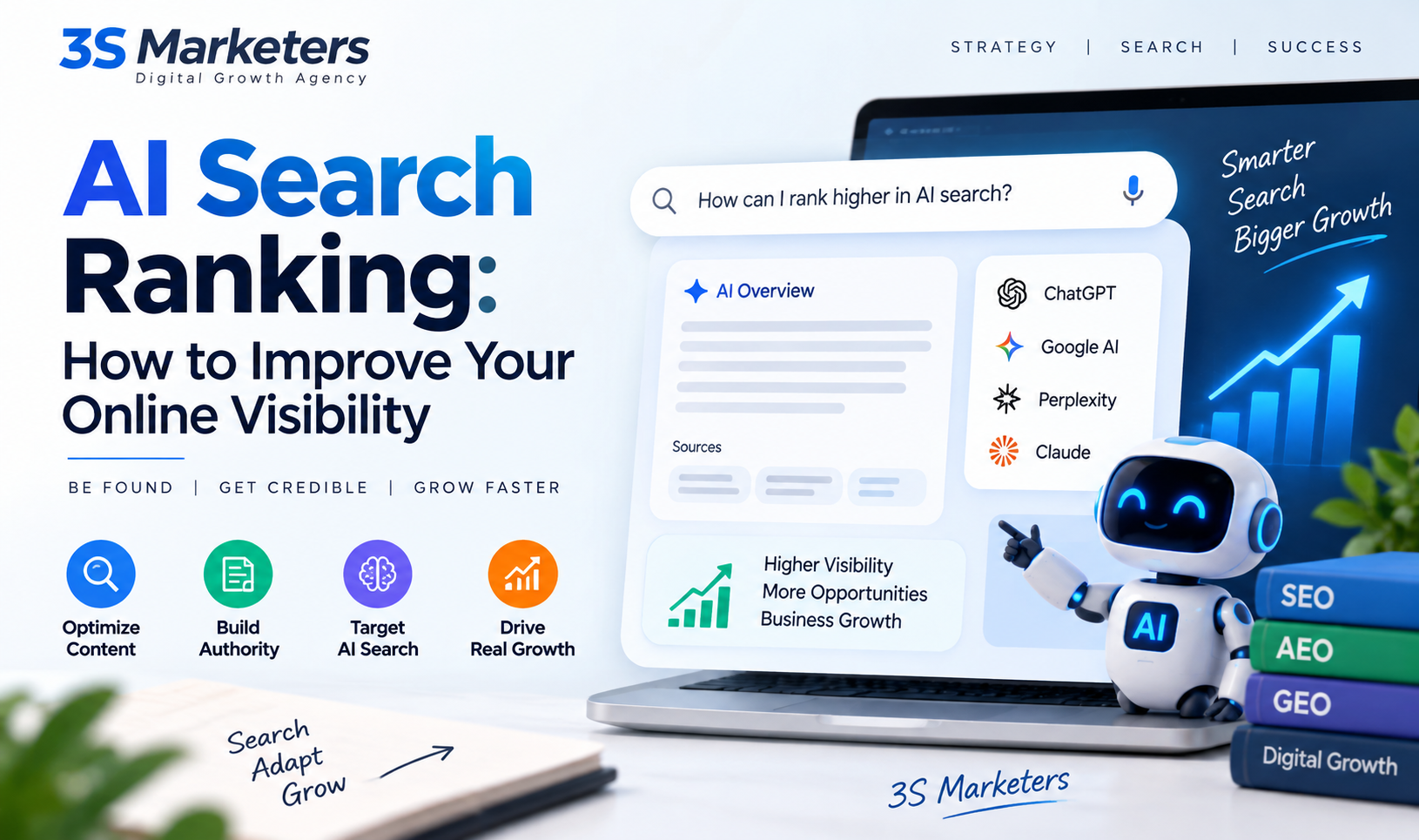
Search is entering a new era for AI search ranking.
For years, businesses concentrated on traditional Google rankings, targeting keywords.
They then optimized webpages to appear on the first page of search results.
Moreover, AI search ranking is shaping how people discover and evaluate information online.
Today, users can ask complex questions in natural language and receive summarized answers. This evolution highlights AI search ranking and how brands can become visible in AI-powered search experiences.
An AI-based search engine can interpret context, understand relationships between concepts, and combine information from multiple sources.
Additionally, this capability supports richer, more comprehensive responses.
This evolving performance can influence AI search ranking over time.
The goal is no longer just to rank a webpage.
The goal is to build content and authority that AI-powered search experiences can understand, trust, and potentially surface when users ask relevant questions.
In this guide, we explore how AI search ranking works, what influences visibility, and what businesses can do today to prepare for the changing search landscape.
What Is AI Search Ranking?
AI search ranking refers to how websites, brands, products, and information may be selected and surfaced within AI-powered search experiences.
Traditional search engines generally organize webpages according to factors such as relevance, quality, authority, technical accessibility, and user experience.
AI-powered search adds another layer.
An AI system may interpret a user’s complete question, identify the intent behind it, retrieve relevant information, and generate a response using information from one or more sources.
For example, a traditional search might return:
“Best SEO companies in India”
An AI-powered search experience could respond to:
“Which SEO agency in India is suitable for a small e-commerce business with a limited marketing budget?”
The second query requires the system to understand several factors, including location, business type, budget, and user intent.
This is why businesses need to optimize for topics, expertise, context, and usefulness—not simply individual keywords.
How Does an AI Based Search Engine Work?
An AI based search engine uses artificial intelligence and machine-learning technologies to understand queries and information at a deeper level.
Although different platforms use different systems, the process can generally involve several stages.
1. Understanding the Query
AI systems analyze the meaning and intent behind a user’s question rather than relying exclusively on exact keyword matches.
2. Finding Relevant Information
The system identifies potentially useful information from available sources.
3. Understanding Context
AI can evaluate relationships between entities, concepts, topics, and questions.
4. Generating or Organizing an Answer
The system may summarize information, provide recommendations, answer questions, or present relevant links.
5. Offering Supporting Sources
Depending on the search experience, users may receive links or references that allow them to explore the original information.
This creates a new opportunity for businesses: becoming a credible source that AI-powered search experiences can identify and use.
Why AI Search Matters for Businesses
AI search is changing the customer journey.
Imagine someone researching a software product. Instead of visiting ten websites, they might ask an AI-powered search tool to compare several solutions, identify the best option, explain pricing differences, and recommend a solution based on their requirements.
This means a potential customer could encounter your brand before visiting your website.
Your business may be:
- Mentioned in an AI-generated answer
- Included as a recommended option
- Referenced as a source
- Linked to from an AI search response
- Discovered through a conversational query
Consequently, AI search ranking is becoming an important consideration for modern digital marketing strategies.
Traditional SEO vs. AI Search Ranking
Traditional SEO and AI search optimization should not be treated as completely separate disciplines.
In fact, they overlap significantly.
Traditional SEO Focuses On:
- Keyword rankings
- Organic traffic
- Backlinks
- Technical SEO
- Search intent
- On-page optimization
- Content quality
AI Search Adds Greater Emphasis On:
- Conversational queries
- Topical authority
- Brand recognition
- Direct answers
- Context and entities
- Original information
- Trustworthiness
- Comprehensive content
The important takeaway is simple:
Strong SEO fundamentals remain the foundation for AI search visibility.
Businesses should improve their existing SEO rather than abandon it in favor of shortcuts or artificial “AI ranking” tactics.
Factors That Can Improve AI Search Visibility
There is no single formula that guarantees inclusion in an AI-generated answer. However, several foundational practices can make a website easier for search systems to understand and evaluate.
Create Helpful, Original Content
AI systems have access to huge amounts of information. Generic content that repeats what every competitor already says offers limited differentiation.
Instead, create content with original value.
Consider adding:
- Original research
- Expert commentary
- Industry examples
- Case studies
- Statistics
- First-hand experience
- Detailed comparisons
- Practical frameworks
For example, instead of publishing another generic “SEO guide,” an agency could publish a detailed case study explaining how it approached a specific technical SEO problem and what lessons businesses can learn from it.
Answer Specific Questions
People use AI tools conversationally.
Your content should address the questions your customers actually ask.
Instead of targeting only:
“SEO services”
create resources answering questions such as:
- How much do SEO services cost?
- How long does SEO take to work?
- What does an SEO agency do each month?
- How can an e-commerce store improve organic traffic?
- What should an SEO audit include?
This approach can help establish deeper topical coverage.
Build Topical Authority
AI search is highly contextual.
If your website publishes one article about SEO and hundreds of unrelated topics, it may be difficult to establish a clear area of expertise.
Instead, develop topic clusters.
For an SEO agency, a content ecosystem could include:
Core Topic: SEO Services
Supporting Topics:
- Technical SEO
- Local SEO
- E-commerce SEO
- International SEO
- Keyword research
- Content SEO
- Link building
- SEO analytics
- AI search
- AI search ranking
Connect these pages using relevant internal links.
This creates a logical structure for both users and search engines.
Make Your Website Easy to Understand
AI systems need to interpret your content.
Clear website architecture can help.
Use:
- Descriptive page titles
- Logical headings
- Short paragraphs
- Lists
- Tables where useful
- Clear navigation
- Descriptive URLs
- Internal links
- Relevant structured data
Avoid hiding important information exclusively inside images or complex interactive elements.
Your most valuable information should be accessible as readable text.
Strengthen Your Brand Authority
AI search visibility is not only about your website.
Your broader digital footprint matters.
Build genuine authority through:
Industry Mentions
Contribute insights to reputable industry publications and websites.
Digital PR
Share original research, trends, data, and expert opinions that journalists and publishers can reference.
Professional Profiles
Maintain accurate business information across relevant professional platforms.
Customer Reviews
Encourage genuine customers to share their experiences where appropriate.
Quality Backlinks
Earn relevant links from credible websites rather than focusing on large quantities of low-quality links.
The goal is to establish your business as a recognizable and trustworthy entity within its industry.
Technical SEO Still Matters
AI search does not eliminate technical SEO.
A website still needs to be accessible, crawlable, indexable, and usable.
Review these areas regularly:
Crawlability
Make sure search engines can access important pages.
Indexation
Check whether valuable pages are properly indexed.
Mobile Experience
Ensure pages work smoothly across smartphones and tablets.
Page Speed
Improve performance and remove unnecessary elements that slow down the website.
Internal Linking
Help users and search engines discover related pages.
Structured Data
Use relevant structured data where appropriate and make sure it accurately represents the visible content.
Technical problems can prevent excellent content from receiving the visibility it deserves.
7 Actionable Tips to Improve AI Search Ranking
If you want to prepare your website for AI-driven search, start with these practical actions.
1. Audit Existing Content
Find outdated, thin, duplicate, or low-value pages and improve them.
2. Add Original Insights
Include data, examples, opinions, research, and experiences that provide genuine value.
3. Target Conversational Questions
Create content around the questions customers ask naturally.
4. Strengthen Internal Links
Connect related pages and create clear topic clusters.
5. Improve Technical SEO
Review crawling, indexation, mobile usability, page speed, redirects, and website architecture.
6. Build Genuine Authority
Earn relevant mentions, editorial links, reviews, and industry recognition.
7. Measure Business Outcomes
Don’t track rankings alone.
Monitor:
- Organic traffic
- Search impressions
- Click-through rates
- Leads
- Sales
- Conversions
- Brand searches
- Relevant AI search visibility
Search visibility only becomes valuable when it contributes to meaningful business results.
Common AI Search Ranking Mistakes
Businesses can make several mistakes when adapting to AI search.
Publishing Large Amounts of Generic AI Content
Using AI to create content quickly does not automatically make that content useful. Human expertise, originality, fact-checking, and editing remain essential.
Keyword Stuffing
Repeating keywords unnaturally can make content difficult to read and does not create genuine topical authority.
Ignoring Traditional SEO
AI search does not mean technical SEO, content quality, links, or website usability no longer matter.
Chasing Every New AI Trend
Search technology changes quickly. Focus on sustainable fundamentals rather than constantly switching strategies.
Measuring Only Rankings
AI search makes visibility more complicated. Brand mentions, qualified traffic, leads, and conversions should also be considered.
How 3S Marketers Can Help
3S Marketers helps businesses build a stronger digital presence through SEO, link building, website development, and broader digital marketing strategies.
As search evolves, the agency’s approach can combine traditional SEO fundamentals with content strategies designed for changing search behavior.
A modern campaign may include:
- Technical SEO
- Keyword research
- Content strategy
- On-page optimization
- Internal linking
- Link building
- Competitor research
- Website optimization
- Content development
- Organic performance analysis
- AI search readiness
The objective is not to chase a temporary ranking tactic. Instead, businesses should build websites and brands that provide useful information, demonstrate expertise, and remain discoverable as search technology evolves.
Conclusion
AI search ranking is becoming an important part of the modern search landscape. As users move toward conversational queries and AI-powered answers, businesses need to think beyond traditional keyword positions.
However, the fundamentals have not disappeared.
Websites still need technically sound foundations, useful content, clear structures, relevant authority, and a strong understanding of search intent.
The biggest change is that businesses now need to think about visibility more broadly.
Instead of asking only, “How do I rank number one?”, marketers should also ask:
“How can I become one of the most useful and trusted sources for this topic?”
That mindset can help businesses prepare for the evolution of AI search while continuing to benefit from traditional organic search.
For companies looking to strengthen their visibility across today’s changing search environment, 3S Marketers can combine SEO, content, link building, and website optimization into a broader digital growth strategy.
The future of search will continue to evolve. Businesses that focus on expertise, usefulness, authority, and sustainable optimization will be better positioned to adapt.
FAQs About AI Search Ranking
AI search ranking describes how information, websites, brands, products, and sources can be selected or surfaced within AI-powered search experiences. It differs from traditional rankings because AI systems may synthesize information from multiple sources.
No. Traditional SEO remains important. Technical accessibility, useful content, search intent, authority, and good user experience continue to provide the foundation for organic visibility.
Focus on helpful original content, strong technical SEO, topical authority, clear website structure, conversational questions, internal linking, brand authority, and genuine industry mentions.
AI can assist with research, outlines, analysis, and content workflows. However, simply producing large amounts of generic AI-generated content is unlikely to create a sustainable advantage. Add human expertise, original insights, accuracy, and meaningful value.
An AI based search engine uses artificial intelligence to understand the meaning and context of queries and provide more conversational or synthesized search experiences. Depending on the platform, it may also provide supporting links and sources.
Businesses with limited internal SEO expertise can benefit from an experienced agency. A good agency can combine technical SEO, content, authority building, analytics, and evolving AI-search strategies instead of relying on one isolated tactic.